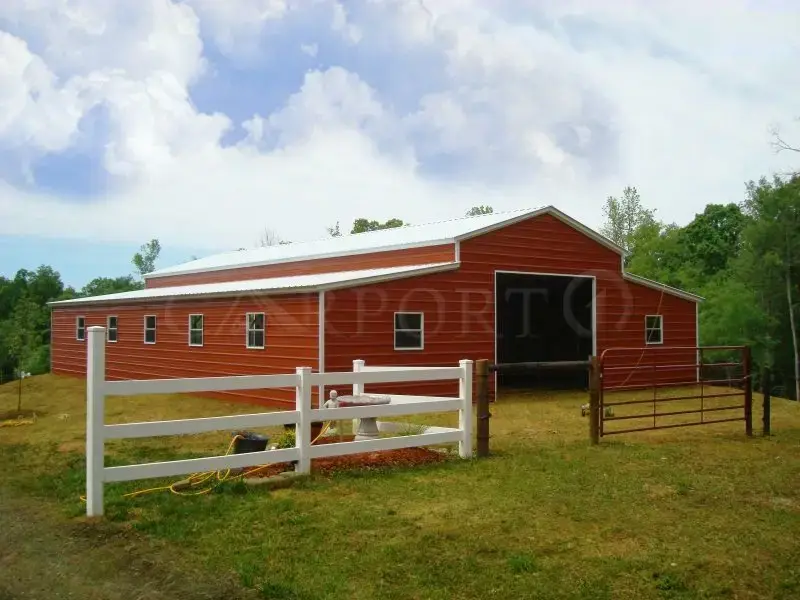
Steel Buildings Built for the Natural State
There is a reason Arkansas property owners have been turning to metal construction at a faster rate than almost any other state in the region. The Natural State packs a remarkable amount of weather diversity into its borders — brutal summer heat and humidity in the Mississippi Delta lowlands, ice storms that cripple the Ozark highlands every few winters, and a tornado season that ranks among the most active in the nation. Add in an agricultural economy that drives demand for large, functional buildings, and you have a state where steel buildings in Arkansas are not just a smart choice — they are increasingly the only choice that makes long-term economic sense. At Carport1, we deliver and install metal carports, garages, barns, workshops, and commercial buildings across Arkansas, engineered specifically for the conditions your property will face.
Arkansas Weather: Four Seasons of Building Stress
Arkansas’s humid subtropical climate means your building absorbs punishment from every direction, in every season. Understanding these patterns is the first step toward choosing the right structure.
Severe Thunderstorms and Tornadoes
Arkansas averages 26 tornadoes per year, with some years producing dramatically more — 1999 saw 107 recorded tornadoes across the state. The primary tornado season runs from March through May, but Arkansas also experiences a dangerous secondary severe weather season in fall and winter. The state’s minimum building code design wind speeds range from 105 to 120 mph, which corresponds to EF0 through mid-EF2 tornado intensity. A properly anchored steel building with 14-gauge or heavier framing provides the structural integrity needed to withstand these events far better than conventional wood construction.
Ice Storms: The Ozark Wildcard
Minor ice accumulations occur somewhere in Arkansas almost every winter, but major ice storms strike every 5 to 10 years and cause devastating damage. The January 2009 ice storm left over 600,000 Arkansas utility customers without power, and more recently the January 2026 winter storm dropped significant ice across the state. Ice loading on roofs, combined with the weight of accumulated snow, can collapse inadequately designed structures. Steel buildings with appropriate snow and ice load ratings handle these events without the catastrophic failures that plague poorly constructed wood buildings.
Heat, Humidity, and Rainfall
Summers in Arkansas are hot and oppressively humid, with average highs in the low to mid 90s and dewpoints that routinely push heat indices above 105 degrees. Annual rainfall averages between 45 and 55 inches across most of the state, with some mountainous areas in the west receiving even more. This combination of heat and moisture is the perfect recipe for wood rot, mold, and termite infestation. Steel is immune to all three — a critical advantage in a state where termite pressure is classified as moderate to heavy throughout.
Agriculture Drives the Market for Metal Buildings in Arkansas
Agriculture is Arkansas’s single largest industry, contributing approximately $20.9 billion annually to the state’s economy. That agricultural backbone creates enormous demand for functional, durable buildings.
Poultry Houses and Chicken Farm Buildings
Poultry is half of Arkansas’s agricultural economy. The state produces over one billion chickens per year, ranks third nationally in both broiler and turkey production, and supports more than 175,000 jobs connected to the poultry industry. Total poultry and egg sales exceed $7.6 billion annually. The poultry industry requires clean, well-ventilated, structurally sound housing — and steel construction has become the industry standard. Our metal agricultural buildings provide the clear-span interiors, proper ventilation integration, and sanitary surfaces that modern poultry operations demand.
Rice and Row Crop Equipment Storage
Arkansas is the nation’s number one rice-producing state, accounting for over 42% of total U.S. rice cash receipts. The state is also a major producer of soybeans, cotton, corn, and feed grains. All of these operations require expensive equipment — combines, tractors, planters, sprayers — that represents hundreds of thousands of dollars in investment. A quality metal equipment barn protects that investment from weather, theft, and UV degradation. Our clear-span designs accommodate the widest farm implements without interior post obstructions.
Cattle Operations
Cattle ranching is significant throughout western and northern Arkansas, and ranchers need hay barns, equipment shelters, and livestock housing that can stand up to the elements. A steel hay barn keeps your investment dry and prevents the spontaneous combustion risk that comes with improperly stored damp hay in enclosed spaces — steel’s non-combustible nature is a genuine safety advantage here.
Beyond the Farm: Metal Buildings for Every Arkansas Property
Residential Garages and Workshops
From the suburban neighborhoods around Little Rock, Fayetteville, and Jonesboro to the rural properties that define most of the state, Arkansas homeowners are choosing metal garages and workshops for their strength, low maintenance, and value. A steel garage resists the humidity-driven rot and termite damage that shortens the lifespan of wood-framed outbuildings in this climate. Add insulation and a mini-split system, and you have a comfortable year-round workspace.
Commercial and Industrial Buildings
Northwest Arkansas — home to Walmart’s headquarters in Bentonville, Tyson Foods in Springdale, and the University of Arkansas in Fayetteville — is one of the fastest-growing metro areas in the country. This growth is driving demand for commercial storage buildings, distribution facilities, small manufacturing shops, and office-warehouse combinations. Steel construction delivers these buildings faster and at lower cost per square foot than conventional construction, with none of the long-term maintenance burden.
Metal Carports and RV Covers
Arkansas’s outdoor recreation culture — from the Buffalo National River to Beaver Lake to the Ouachita Mountains — means plenty of boats, ATVs, side-by-sides, and RVs that need covered storage. Our metal carports in Arkansas start with single-vehicle coverage and scale up to triple-wide configurations. Tall-leg options accommodate RVs and boats with ease.
Regional Building Considerations Across Arkansas
The Ozark Plateau — Northwest Arkansas
This is the hilliest and coldest part of the state, with elevations reaching 2,500 feet in the Boston Mountains. Winter brings meaningful snow and ice accumulation — 10 to 20 inches of snowfall annually, plus periodic ice storms. Metal buildings in this region need roof snow load ratings of at least 15 to 20 psf, and steeper roof pitches help shed accumulation. The booming Fayetteville-Springdale-Rogers metro has strict municipal building codes, so plan for a permit and engineered drawings.
The Arkansas River Valley and Central Arkansas
From Fort Smith through Little Rock, this region sits in the heart of Tornado Alley’s southeastern extension. Design wind speeds of 105 to 115 mph are standard in building codes here. The terrain flattens compared to the Ozarks, and summer heat is more intense. This is the geographic transition between the state’s hill country and its delta lowlands, and building needs reflect that blend — agricultural storage, suburban garages, and commercial construction are all in high demand.
The Mississippi Delta — Eastern Arkansas
The flat, fertile delta counties along the Mississippi River are the heart of Arkansas’s rice and row-crop agriculture. This region is also the hottest, most humid, and most flood-prone area of the state. Metal buildings here need to be elevated above flood levels where applicable, and the combination of extreme humidity and pest pressure makes steel construction dramatically superior to wood. Equipment barns, grain storage buildings, and agricultural workshops dominate the landscape.
Arkansas Building Permits and Code Requirements
Arkansas building codes are primarily enforced at the local level, and the stringency varies significantly between jurisdictions:
- Major cities (Little Rock, Fayetteville, Fort Smith, Jonesboro) require building permits for virtually all permanent structures and typically reference the International Building Code (IBC) 2021 or a recent prior edition.
- Smaller towns may have simplified permit processes or limited code enforcement staff.
- Unincorporated county areas — which cover most of the state’s land area — often have minimal permit requirements. Many rural Arkansas counties do not require permits for agricultural buildings or residential accessory structures below certain size thresholds.
- Design wind speeds in the Arkansas building code range from 105 to 120 mph, based on ASCE 7 standards.
- Flood zone regulations apply in river corridors and delta lowlands — the National Flood Insurance Program (NFIP) requirements may dictate elevation and anchoring standards for structures in these areas.
Carport1 provides certified engineering documents and can configure your building to meet the specific requirements of your local jurisdiction. We handle this every day across Arkansas and know the process well.
Partner with Carport1 for Your Arkansas Metal Building
We have built our reputation in Arkansas on delivering quality structures that are engineered for the specific challenges this state presents — tornadoes, ice, heat, humidity, and everything in between. Here is what sets us apart:
- Free Delivery and Installation — We deliver and install your building on your prepared site at no extra cost. Our experienced crews handle the entire process.
- Built for Arkansas Weather — Every building is configured with the gauge, anchoring, and certification appropriate for your county’s wind and snow load requirements.
- Full Customization — Choose dimensions, roof style, panel colors, door sizes and locations, windows, insulation, and more. Your building, your specifications.
- Agricultural Expertise — We understand what Arkansas farmers and ranchers need, from clear-span poultry house dimensions to equipment barn door configurations.
- Financing Available — Rent-to-own and traditional financing options make your metal building affordable.
Get started today. Call 1-877-242-0393 or request your free quote. We will help you design the perfect building for your property and your budget.
Frequently Asked Questions: Metal Buildings in Arkansas
What gauge steel should I choose for a metal building in Arkansas?
For most applications in Arkansas, we recommend 14-gauge steel framing as the minimum. This provides the structural strength needed to handle the state’s severe wind events and occasional ice loading. For larger commercial or agricultural buildings, or for properties in high-wind corridors, 12-gauge framing offers additional strength and rigidity.
Can a metal building survive an Arkansas tornado?
No above-ground structure — regardless of material — is guaranteed to survive a direct hit from a strong tornado. However, a properly engineered and anchored steel building significantly outperforms wood construction in high-wind events. The connections between the frame, panels, and foundation are the critical points, and our buildings are designed with reinforced connections that resist uplift and racking forces. For tornado shelter purposes, we recommend a dedicated safe room within or adjacent to your metal building.
Do I need a permit for a metal carport in rural Arkansas?
Many rural, unincorporated areas of Arkansas do not require building permits for residential carports and accessory structures. However, this varies by county, and some counties have adopted permit requirements in recent years. Contact your county judge’s office or county building inspector to confirm. Even where permits are not required, we still recommend proper anchoring and engineering appropriate for your area’s wind and weather conditions.
How does a metal building handle Arkansas humidity?
This is actually one of the strongest arguments for steel construction in Arkansas. Wood framing in this climate is under constant attack from moisture, mold, and termites. Steel is not affected by any of these threats. For enclosed buildings, we recommend adding ventilation (ridge vents, gable vents, or louvers) to manage interior condensation, and optional vapor barrier insulation for climate-controlled spaces. With proper ventilation, a steel building in Arkansas will last decades longer than an equivalent wood structure.
What roof style works best in Arkansas?
We recommend vertical roof panels for most Arkansas installations. The vertical orientation allows rain, ice, and debris to shed quickly off the roof surface. This matters in a state that receives 45 to 55 inches of rainfall annually and experiences periodic ice storms. Vertical roofs also provide a cleaner appearance and have a longer lifespan than horizontal panel configurations because water does not pool on the panel ribs.